Phrenology
“At Homes:” A personal form of performance developed in 1808 by theatre manager and comic actor, Charles Mathews. After years of playing supporting roles alongside the era’s luminaries, Mathews was eager to show the public that he was capable of much more. He began staging a series of solo performances that he called “at homes” – as though inviting the audience to join him , not for a show, but for a pleasant evening of parlor entertainment in his company. Over the course of the evening, Mathews would introduce audiences to as many as 30 different characters of varying ages, genders, occupations, classes, and nationalities, through forms of storytelling, lecturing, and comic vignettes. Mathews enchanted audiences by transforming into each of his satirical characters one after another in 30 seconds or less. Some of his most celebrated “at homes” are: At Home or Mathews at Home (1808), Travels in Air, on Earth, and on Water (1821), Trip to America (1824) and Invitations (1826).
Casting: The process whereby a 3D plaster mould is made of a living subject’s head so that it accurately captures the subject’s features for phrenological examination. Casting was generally an unpleasant experience for the subject, as the face had to be layered with wet plaster, and straws inserted into the subject’s nose so that they could breathe. The subject then had to remain perfectly still during the casting process in order to allow for the plaster to accurately capture their heads.
Cecilia Siddons: Cecilia Siddons (1794-1868) was the daughter of the famous tragedienne, Sarah Siddons, and actor William Siddons. In 1833, phrenologist George Combe, who was an avid theatregoer and close friend of Siddons’ cousin Fanny Kemble, married Cecilia Siddons.
Charles Mathews: Charles Mathews (1778-1835) was an English theatre manager and comic actor. After years of playing supporting roles, in 1808, Mathews decided to create his own form of performance, one that would enable him to show off his talent for mimicry and versatility; the one man show. In Mathews’ one man show: At Home or Mathews at Home, Mathews performed a variety of characters, each of which was based off of different people he encountered and observed in real life. Mathews quickly captivated audiences with his impressions, poetry recitations, comical songs, storytelling, and most of all, with his ability to quickly transform from one character to another before their very eyes. Like many successful performers of the time, Mathews was also satirized by Charles Dickens, who based his 1837 character Alfred Jingle (The Pickwick Papers) off of Mathews and his work. Today, the one man show still remains a popular and poignant form of performance.
Clara Fisher: Clara Fisher (1811-1898) was an Anglo-American actress who made her debut at six years old in David Garrick’s Lilliput as Lord Flimnap (1817). From there Fisher went on to perform Richard III, Young and Old, or The Four Mowbrays, and much more. Fisher was greatly admired for her extraordinary ability to accurately play male, female, and adult roles, even though she was still very young. In 1820, just before her 9th birthday, phrenologist George Combe made a plaster cast of her head in order to do a phrenological reading. Combe concluded that Fisher’s ability to successfully perform adult roles was due to the particular combination of mental faculties, and their large size.
Cranioscopy: An early method developed by Franz Joseph Gall, which argued that a person’s character traits, and the development of their mental and moral faculties could be determined by studying, and feeling the exterior shape of the skull. Gall believed that the bumps, and varying shapes of the human skull were created by the pressure exerted by the brain, and as a result, served as a good indicator of how developed, or underdeveloped a person’s faculties were. This method became central to the study of Phrenology.
Edinburgh Phrenological Society: The Edinburgh Phrenological Society was the first official group dedicated to the study of phrenology, in Great Britain. The group was formed in 1820 by leading phrenologist George Combe and his brother Andrew Combe, and soon inspired the establishment of over 40 other similar societies throughout Britain. The Society was extremely influential, until around 1840, when interest in phrenology began to decline. The Society’s final meeting was held in 1870. Some key members of the Edinburgh Phrenological Society were: William A.F. Browne, James Crichton-Browne, and Robert Chambers.
Fanny Kemble: Fanny Kemble (1809-1893) was a prominent British actress from a theatre family in the mid 19thcentury. In addition to her work as an actress, she was also a well-known writer who wrote plays, poetry, eleven volumes of memoirs, and pieces of travel writing. She was also a close friend of George Combe.
Franz Joseph Gall: Franz Joseph Gall (1758-1828) was a German anatomist and physiologist credited with founding phrenology. As a young boy in school, Gall became fascinated with his classmate’s uniquely shaped head and high intellect. He began to wonder how the size, or shape of a person’s skull could be used to help determine the strength of their mental faculties. As he continued his studies at Strasbourg University in Vienna, Gall developed a working theory for this idea entitled: “Organology,” and a scientific method entitled: “Cranioscopy,” which were later merged by his assistant, J. G. Spurzheim, and established as Phrenology (1796). Over the course of his life, Gall collected, and examined over 120 skulls to test and prove his hypothesis. Though much of his work is now considered a branch of pseudoscience, Gall’s phrenological research contributed, not only to the establishment of psychology as a formal science, but also to some of the initial (and highly troubling) theories of evolution, anthropology, and sociology.
George Combe: George Combe (1788-1858) was a leading phrenologist in England during the first half of the 19thcentury. His book, The Constitution of Man (1828) made important contributions to the field of phrenology, and to natural sciences more broadly. In 1833 he married Cecilia Siddons, daughter of the celebrated British stage actress Sarah Siddons, and was also a close friend of actress Fanny Kemble. Through scientific lectures, and his book, Combe played a key role in the dissemination and popularization of phrenology in Britain.
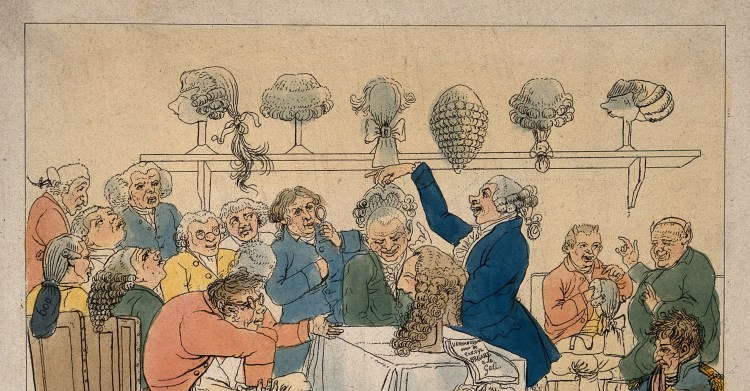
George Stevens: George Stevens (1710-1780) was an English actor, playwright, songwriter, and poet. He spent most of his career as a travelling performer and wrote many popular drinking and patriotic songs. His most successful, and well-known piece of writing is a satirical, one-person play entitled The Lecture on Heads (1764), which he performed himself in England, Ireland, and the US. The play was a parody on physiognomy, and mimicked the form of an academic lecture.
J. G. Spurzheim: Johann Gasper Spurzheim (1776-1832) was a German physician who assisted Franz Joseph Gall in the creation and dissemination of phrenology. Together, Gall and Spurzheim co-wrote, and co-presented their phrenological theories, popularizing it as a form of science, throughout Europe. In addition to merging Gall’s theory of Organology and method of Cranioscopy, Spurzheim also helped to expand the number of phrenological faculties. In 1812, Spurzheim and fell out with Gall and left him to pursue his own career. He continued to build on the work he did with Gall, and published his own writing on phrenology, including the book: Philosophical Catechism of the Natural Laws of Man, in 1833.
Licensing Act 1737: An act in Great Britain that was intended to censor what was being said about the government in theatrical plays. The act only permitted two theatres: Drury Lane and Covent Garden. Stevens’ Lecture on Heads was able to get around the act, as his performance was categorized as a lecture, as opposed to a play.
Localization: The process wherein the brain is divided into different sections, each corresponding to a specific mental faculty. This process was created and performed by Franz Joseph Gall.
Monopolylogue: Originated by Charles Mathews in 1808 with his “at home theatricals,” the monopolylogue is a form of performance wherein one performer plays multiple characters consecutively. These characters may, or may not interact with one another.
Organology: An early theory developed by Franz Joseph Gall that, along with Cranioscopy,” later became known as Phrenology. Organology argues that the mind is made up of a group of separate entities (faculties) within the brain that function independently of one another.
Phrenological Faculty: After identifying the different organs of the skull, Franz Joseph Gall assigned a specific human trait, to each one, and called them faculties. Along with the help of J.G. Spurzheim, Gall identified a total of 27 (later 33) mental faculties. These faculties were grouped into two orders. Order 1 contained faculties relating more so to emotions and characteristics such as benevolence, while order 2’s faculties were more related to intellect, perception, etc. (i.e. sense of time).
Phrenological Organ: Franz Joseph Gall divided the human skull into different sections, according to area, and shape, and called them organs. Each organ is matched with a corresponding mental faculty. There are 33 in total.
Phrenologist: A person who practices and studies phrenology. Phrenologists would study the overall shape and particular bumps and grooves on the skulls of deceased patients, as well as the plaster casts of living subjects, as a means of determining a person’s dominant character traits. A few well-known phrenologists of the 19th century include: Franz Joseph Gall (Germany-Austria) J.G Spurzheim (Germany), George Combe (England), and Orson and Lorenzo Fowler (USA).
Phrenology: A branch of pseudoscience that enjoyed immense popularity in the 19th century. Through the study of human remains and living subjects, phrenologists examined the relationship between the size and shape of a subject’s skull, and their mental faculties. As the field developed, phrenologists grouped each of the brain’s faculties into two Orders and six Genera for a total of 27 (later 33) faculties, each linked to a specific characteristic, or trait (i.e. benevolence). Phrenologists believed that feeling the bumps, and studying the overall shape of a human head could enable them to determine the strength of each of the subject’s faculties, and in so doing, determine their dominant character traits. This field of study first developed in Vienna, through the work of phrenologist, Franz Joseph Gall, and was later popularized in England through the work of George Combe.
Phrenomesmerism: A branch of pseudoscience that merged phrenological theories with emerging theories around animal magnetism, or mesmerism. Established in 1842-1843 by Drs R.H. Collyer and La Roy Sunderland, phrenomesmerism claimed that when put into a mesmeric trance and touched on a particular phrenological organ, a patient would begin to exhibit the corresponding phrenological faculty tied to that organ. (I.e. if their benevolence organ was touched, the patient would act benevolent). Phrenomesmerism helped to temporarily sustain interest in phrenology, and also played a role in its demise.
The Constitution of Man: First published in 1828, The Constitution of Man was an important phrenological text of the 19th century. Written by George Combe, The Constitution of Man provided an introduction to phrenological theory, as well as introduced Combe’s theories of hereditarianism, wherein he links the inheritance of mental faculties to theories of phrenology. As a result, The Constitution of Man was central to the distribution of phrenology, and pre-Darwin notions of hereditarianism, thus making a significant contribution to phrenology, and to the field of natural science more broadly.
The Lecture on Heads: A one-person show, written and performed by George Stevens, in 1764. Drawing from the format of an academic lecture, Stevens (playing himself) presents numerous wooden and papier maché heads, each of which represented a stereotypical character (i.e. old maid, fop, politician, etc.). The performance served as a parody of physiognomy, and was appealing to audiences in England, India, British North America, and the Caribbean.
The Royal Society: The Royal Society is the oldest national scientific institution in the world. Founded in 1660, the Royal Society continues to present public scientific lectures today. Some notable past lecturers include: Thomas Garnett, Humphrey Davy, and Michael Faraday.
The Virtuoso: The Virtuoso was a well-received restoration comedy written by Thomas Shadwell. It premiered at Dorset Garden in 1767 and notably parodied The Royal Society. It was also the first play to feature a scientist character.
Performance-Based Research
Cultural Memory: A form of collective memory that holds the history and identity of a particular culture. Cultural memory may be expressed through gesture, music, images, rituals, stories (both oral and written), dance, and much more. According to Katherine Newey, cultural memory serves as an important reminder to theatre historians that historiography comes from memory, not just written word. For more on this please see: “Embodied History: Reflections on the Jane Scott Project” by Katherine Newey.
Embodied Knowledge: A form of unconscious knowledge that is situated within the body and is demonstrated through muscle memory (gesture, movement, etc), and inherited idiosyncrasies (speech, characteristics, habits, etc.).
Ethnodrama: A form of performance-based research wherein ethnographic research data (i.e. an interview transcript, field notes, etc.), is converted into a dramatic playscript. According to Kathleen Gallagher, this conversion process may be referred to as “respectful forgeries and faithful betrayals,” wherein the emphasis is on respectfully and accurately portraying the essence of the event, subjects, etc., rather than on perfectly re-creating, or re-staging the event. For more on this, please see: “Theatre Pedagogy and Performed Research: Respectful Forgeries and Faithful Betrayals” by Kathleen Gallagher.
Experimental Archaeology: An archaeological research strategy, wherein the researcher/archaeologist utilizes historical record to reconstruct a historical artefact such as a prop, tool, ancient technology, etc., as a means of better understanding how it was made and used.
Historiography: The study of historical writing, including the study of historical writing based on the close analysis of primary and secondary sources that provide details around the historic event.
Microhistory: A method of studying history that focuses on specific interactions performed by individuals or small groups of people, as a means of determining their ideas, beliefs, practices, actions, intentions, etc.
Practice-based research: Also known as “performance as research (PAR),” “performance-based research,” “arts-based research,” “applied research,” and “devised research,” practice-based research is a research method that merges artistic and scholarly practices as a means of investigating theoretical concepts and theory-based research questions through performance. In so doing, performance-based research has the ability to bring the past into the present moment, as contemporary researchers embody the behavioural, gestural, emotional, visual and aural ways in which people may have conducted themselves in the past. Initially, practice-based research aimed to re-stage/re-enact historical moments through performance. However, in recent years, this essential research method has become more about reviving history, wherein researchers respect the framework through which the historic moment initially took place, but also leave space for adaptation, exploration, and the ability to challenge, or resist aspects of the historical record. Some important questions contemporary scholar Kathleen Gallagher has posed around practice-based research are: “How does the stage instruct?” “What are the scientific, artistic, and pedagogic gains/risks?” “What are the artistic limits?” “Can learning/experiencing theatre validate knowledge differently?,” and “how is knowledge disseminated differently in performance research?” For more on this, please see: “Theatre Pedagogy and Performed Research: Respectful Forgeries and Faithful Betrayals” by Kathleen Gallagher.
Pure Research: A form of performance as research developed by Canadian theatre company: Nightswimming, wherein researchers work in a free form, lab environment to explore a creative question through devising/collective creation. By not requiring participants to conclude their research with a public performance, Nightswimming permits their researchers to engage in in-depth exploration, creation and discovery as a form of research.For more on this please see, “Locating the Artist-Researcher: Shifting Sites of Performance as Research (PAR) in Canada” by Laura Levin.
Research/Creation: A category of performance as research established in 2003 by Canada’s federal funding agency: SSHRC (Social Sciences and Humanities Research Council of Canada). In order to be considered a Research/Creationproject, SSHRC requires the project to be rooted in theory, and for the project researchers to use a methodological approach, and address theory-based research questions. Due to SSHRC’s emphasis on the delivery of a final product, contemporary theatre and performance studies scholar, Laura Levin argues that this category of funded research should be considered “Research and Creation” as opposed to “Research as Creation.” For more on this please see, “Locating the Artist-Researcher: Shifting Sites of Performance as Research (PAR) in Canada” by Laura Levin.
Revival: A form of performance-based research, reviving in the context of performance history is the act of reimagining, or reconstructing a particular moment, or moments in history using: text, voice, gesture, movement, lighting, sound, staging, props, etc., as a means of studying, analysing, questioning, and/or understanding it in the present. Unlike re-enacting, reviving does not necessarily mean recreating, or re-staging the event exactly as it occurred in the past, but leaves space for exploration, interpretation, adaptation, and resistance.
Role Play: In the context of performance as research, role play is a research strategy wherein a researcher revives a role from the historical project as a means of gaining a better understanding of what the role was, how it was performed, how it may have been perceived, etc. This role may take numerous shapes/forms, but frequently involves the researcher playing the part of a character, such as the “Old Maid” in George Stevens’ piece, The Lecture on Heads.
Urban Intervention: A form of performance as research that aims to combine art, politics, and everyday life through performative research projects that focus on a specific aspect of urban life, including but not limited to: how bodies relate to one another in urban spaces, how urban environments shape urban life, and how bodies are influenced by their physical surroundings in urban environments. For more on this please see, “Locating the Artist-Researcher: Shifting Sites of Performance as Research (PAR) in Canada” by Laura Levin.
 performingphrenology.com