Phrenology: An Introduction
In the late 18th century German anatomist and physiologist, Franz Joseph Gall discovered what he believed was a direct correlation between the size of the brain and its constitutive organs. Working from this premise, Gall and his student-turned collaborator, J. G. Spurzheim developed a set of scientific methods and theories that formed the basis for one of the most popular (and troubling) branches of science in the 19th century: phrenology.
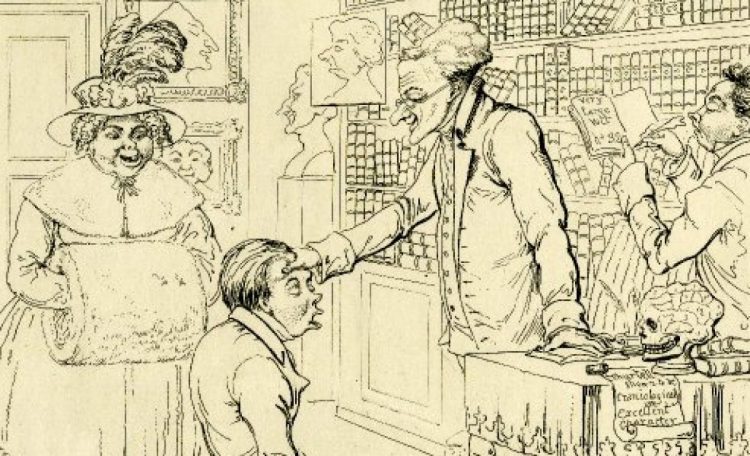
What is Phrenology?
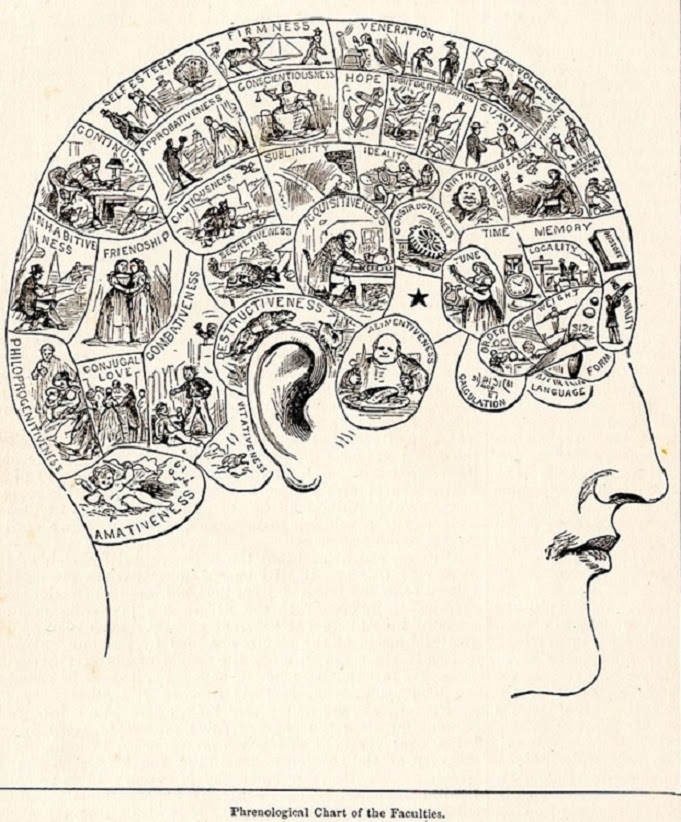
Through the study of human remains and living subjects, Gall and Spurzheim examined the relationship between the size and shape of a subject’s skull, and their mental faculties. As their research developed, Gall and Spurzheim grouped each of the brain’s faculties into two Orders and six Genera for a total of 27 (later revised by Spurzheim to 33) faculties, each linked to a specific characteristic or trait (i.e. benevolence). Gall and Spurzheim believed that by feeling the bumps and studying the overall shape of a human head, they could determine the strength of each of the subject’s faculties, and in so doing, determine their dominant character traits.
The Popularization of Phrenology
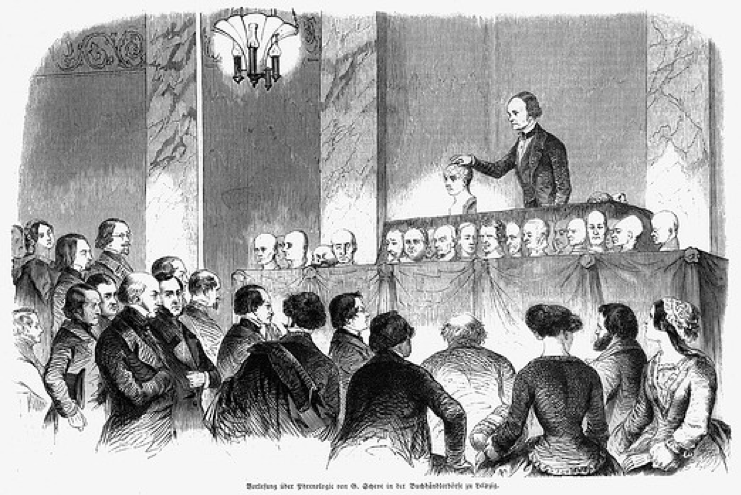
Before long, Gall and Spurzheim’s phrenological theories gained traction, and with the formation of the Edinburgh Phrenological Society in 1820, became a prominent branch of science by the early 19th century. Phrenology continued to enjoy immense popularity, thanks in large part to the proselytizing efforts of scientists like: Bernard Hollander (1864-1934), Orson Squire Fowler (1809-1887), Lorenzo Niles Fowler (1811-1896), James De Ville (1777-1846), and George Combe (1788-1858). In particular Combe’s lecture tours of Britain, Europe, and North America were wildly popular with white middle-class audiences, and his 1828 book, The Constitution of Man became one of the most widely read publications of the period. However, 19th century scientists cannot take all the credit for the popularization of this new field of science.

Scientific Lecture As Theatrical Performance
In 1737, the Licensing Act in Great Britain only permitted two theatres: Drury Lane and Covent Garden. As a result, actors in the 18th century began to take up an alternate form of performance: the academic lecture. The academic lecture was an effective way for actors to continue performing, despite the restrictive act, as a lecture performance technically wasn’t considered to be a show.
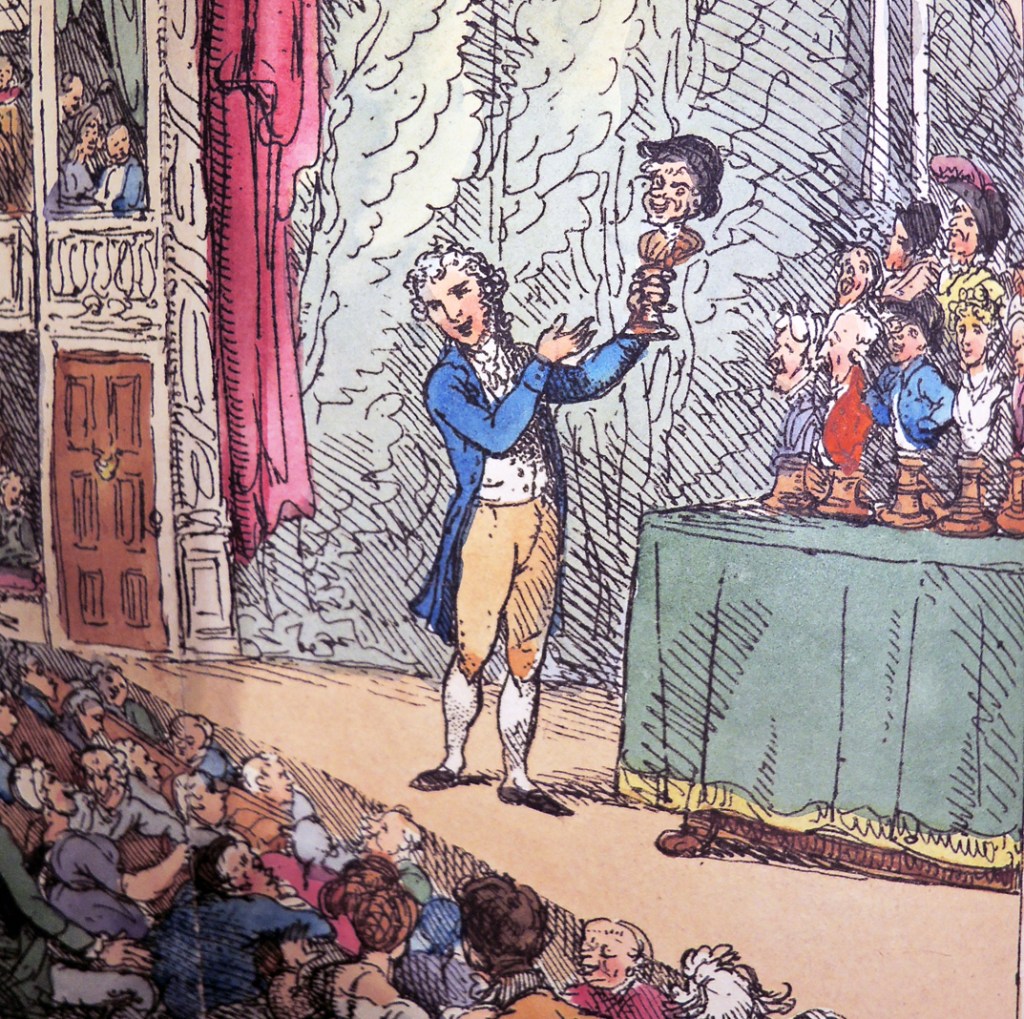
Many 18th century performers borrowed from the scientific lecture style, including George Alexander Stevens (1710-1780), who was an English actor, playwright, songwriter, and poet. In 1764 Stevens wrote and performed his most famous satirical piece entitled: The Lecture on Heads, wherein Stevens (playing himself as a lecturer) parodies the physiognomy of a number of archetypal character types by holding up a series of wooden and papier maché character heads. The similarities between Stevens’ 18th century performance and the popular phrenological lectures that arose in the 19th century serves as one of many notable examples of how the fields of theatre and 19th century science overlapped, borrowed from one another, and evolved together. This idea is taken up further in our first research workshop entitled: The Lecture on Heads A Performance-Based Research Workshop
Although today phrenology is considered a form of pseudoscience, Gall and Surzheim’s phrenological research contributed, not only to the establishment of psychology as a formal science, but also to some of the initial theories of evolution, anthropology, and sociology. To read more about the history of phrenology, click here.
 performingphrenology.com